I Built a School Psychology Video Game with an AI Agent
Key Takeaways
An AI agent can help turn a rough idea into a working product, but it still needs a person to define the purpose and judge the result.
Building something useful requires repeated cycles of creating, testing, finding problems, and revising—not one perfect prompt.
Automated checks can catch many failures, but direct human use reveals problems that code alone may miss.
The professional remains responsible for the values, accuracy, tone, and boundaries built into the final product.
Sometimes the best way to understand an AI agent is to make something enjoyable with one.
I originally expected this to be a three-part series about AI agents. Post 1, Post 2, and Post 3 are already available. But as I wrote the series and used agentic systems on more real projects, each practical experience raised another question—and gave me another concrete example worth exploring. The series grew along with the work.
Before going further into this series, I wanted to pause and keep this fun. So I used Codex in an agentic collaboration to help me build a video game about school psychology.
I use agentic deliberately here. Codex worked across a multistep project, used tools, created and revised files, tested the game, and returned to me for direction and approval. It did not independently invent, approve, and release the game. Depending on how narrowly the term agent is defined, “agentic collaboration” is more precise than describing the entire project as the work of a single autonomous agent.
The result was School Psych Quest: One More Day, a browser-based game in which the player tries to complete a defensible psychoeducational evaluation during one very busy school day. Along the way, the player manages interruptions, missing information, technology problems, professional decisions, limited energy, and the central challenge of eventually going home.
The game is fictional, but the collaboration behind it offers a concrete example of what an AI agent can—and cannot—do.
The Goal Was Always Old-School
I did not want School Psych Quest to look or feel like a modern action game. The goal was to create something closer to an Apple IIc- or Commodore-era school adventure: simple pixel-style graphics, keyboard controls, clearly defined choices, limited resources, and more imagination than visual realism.
That choice shaped the humor and the design. The game is deliberately compact. It asks the player to read, explore, make decisions, and live with the consequences. It feels more like something that might have arrived in a cardboard box with a floppy disk and a small instruction manual than a contemporary game built around cinematic graphics.
You can play it on a phone, and we added touch controls and a rotate-to-landscape cue. But it is really intended to be played on a desktop computer with a keyboard. After all, it is a 1980s game.
The Idea Was Mine, but I Did Not Build It Alone
I began with a concept rather than a technical specification. I wanted a game that captured some of the absurdity, pressure, and professional judgment involved in school psychology. The humor could target paperwork, impossible schedules, confusing roles, malfunctioning technology, and the everyday complications of school life. It could not make students, families, disability, or vulnerability the joke.
I also wanted the player to do more than move around a cartoon school. The choices needed to reflect recognizable professional decisions. The player would have to verify consent, gather information, complete an observation, establish rapport before testing, review rating scales, write an integrated report, prepare for a meeting, and respond appropriately when confidential information appeared where it should not.
I brought the professional purpose, the boundaries, the scenarios, and the judgment about what felt authentic. The agent brought a different set of abilities. It could create a project, write and revise the code, organize the files, build the rooms and interactions, run automated checks, open the game in a browser, document problems, and prepare a version that could be placed on a website.
This was not a matter of typing, “Make me a video game,” and receiving a finished product.
It was much closer to supervising a capable but uneven intern.
The Agent Could Build, but It Could Not Decide What the Game Should Mean
An intern can sometimes produce an impressive amount of work quickly. That does not mean the intern understands the assignment in the same way the supervisor does.
The agent could create a classroom, office, hallway, cafeteria, playground, and meeting room. It could make characters move, track decisions, save progress, and produce different endings. It could build systems for Energy, Trust, Professional Integrity, and Evaluation Progress.
But it could not independently decide whether a scenario represented responsible school psychology. It could not determine whether the humor felt fair, whether a testing interaction respected rapport, or whether a consequence communicated the right professional lesson. Those decisions depended on my experience and values.
That division of labor mattered. I was not simply approving the appearance of the game. I was acting as the subject-matter expert and product owner. The agent was helping turn that direction into a functioning system.
My First Playthrough Found Problems the Agent Had Missed
One of the most useful moments came when I tried to play the game myself.
The title screen looked as though it had clickable buttons. It did not. The agent had confirmed that the keyboard controls worked, but a normal user could reasonably click a visible option and conclude that the game was broken.
The hallway had a similar problem. The routes to rooms existed in the code, but the doorways were not visually obvious. Technically, the rooms were accessible. Practically, I could not tell where to go.
These were not obscure software defects. They were failures to see the game from the player’s perspective.
After I identified them, the agent revised the title screen to support clicking and tapping, redesigned the hallway as a recognizable corridor with labeled doors, and tested the changes in the browser. A return route from the playground received the same treatment after we found that it relied on an invisible boundary.
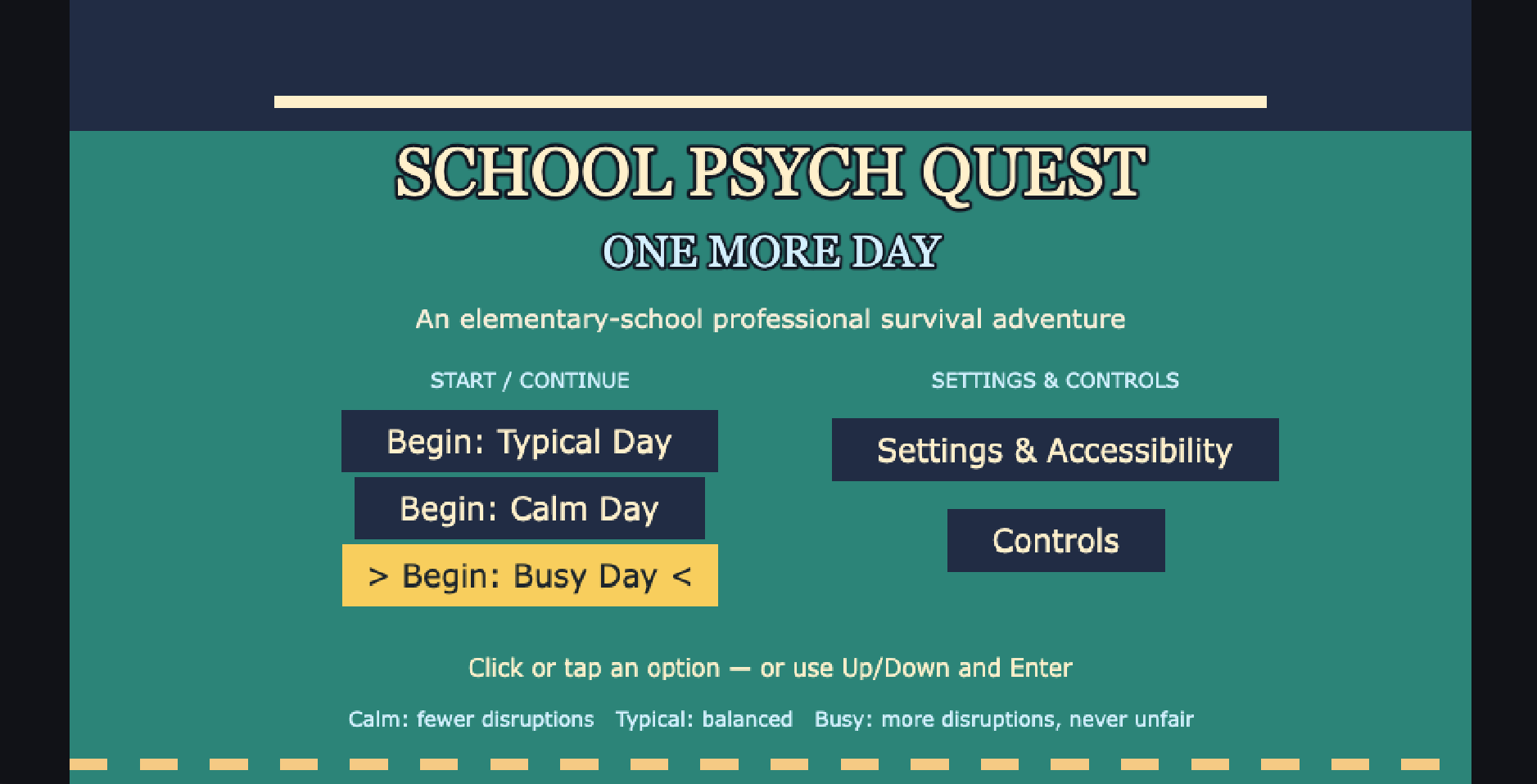
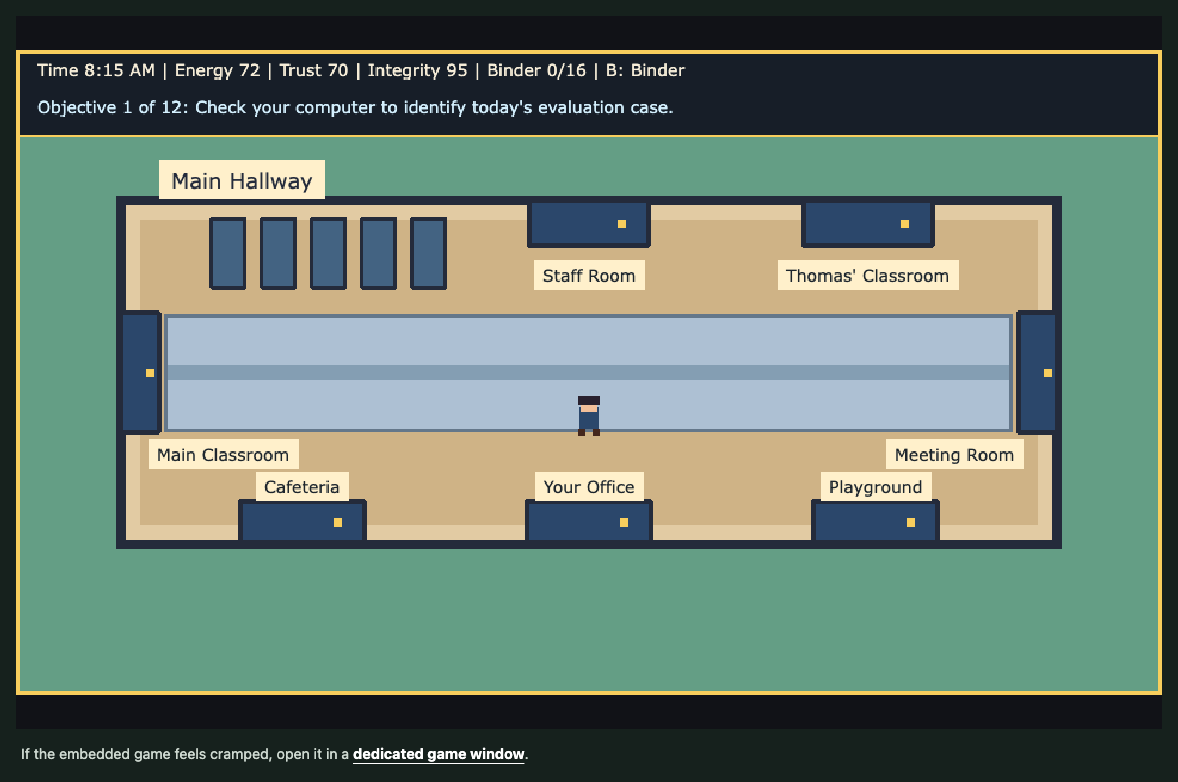
The lesson extends beyond video games: a system can pass its own checks and still fail the person using it.
We Debugged the Professional Logic, Not Just the Code
Some problems were less visible but more important.
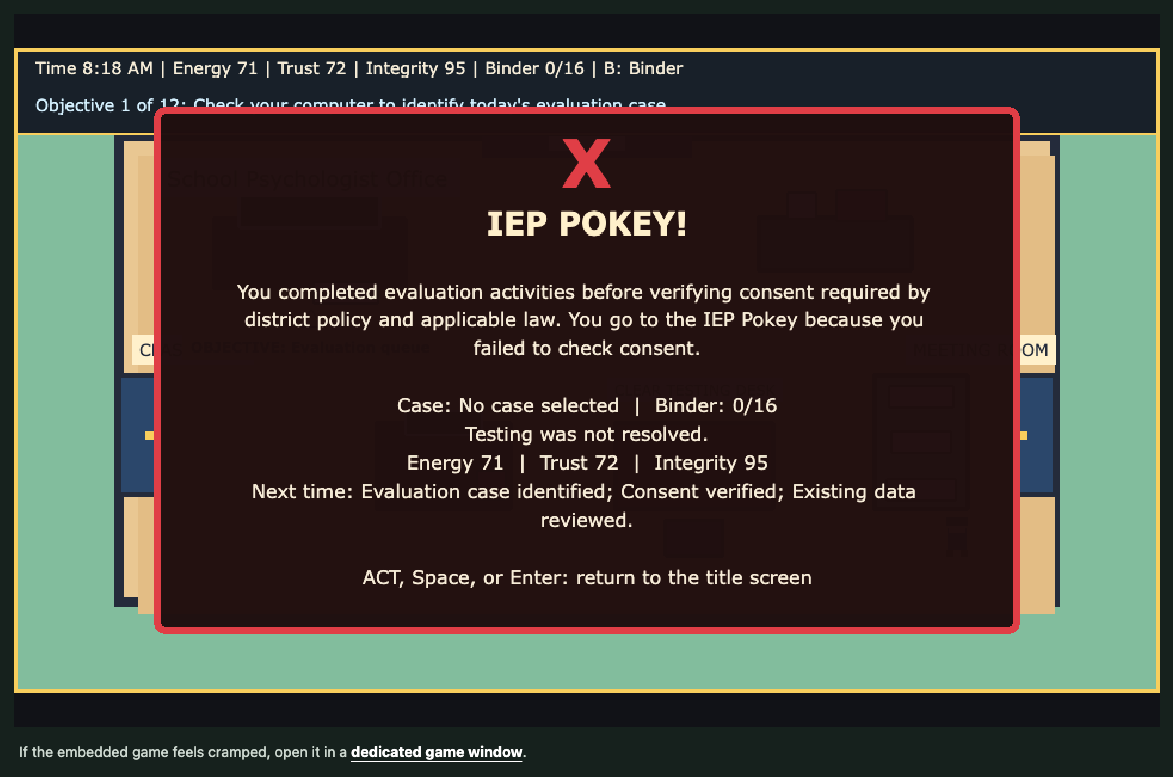
In an early testing sequence, the player could move too quickly from locating a student to administering a test. That may have made the game progress, but it did not adequately represent rapport, explanation, or the student’s response to the situation.
We revised the sequence so that the player has to engage with the fictional student before valid testing can occur. If the player begins testing without that preparation, the student may refuse and return to class. The player then has to retrieve him and approach the interaction differently.
That was not merely a feature request. It was a correction to the professional model embedded in the game.
The same principle shaped privacy events, withdrawn consent, invalid testing, missing rating scales, report writing, and the endings. A game about school psychology inevitably teaches something through its rules. If the rules reward shortcuts or treat professional safeguards as decorative, the game communicates the wrong lesson even if it runs perfectly.
The Agent Helped Stress-Test What We Built
Once the main routes worked, the agent did more than replay the game the same way.
It created repeatable test conditions so the same sequence could be reproduced. It checked successful routes involving two different fictional cases, as well as a route in which the player pushed ahead with invalid testing and reached an intentionally poor ending. It tested saving and resuming, different levels of school-day disruption, phone-sized layouts, keyboard and touch controls, and screen-reader information.
The project also accumulated automated checks for the underlying logic. Those checks helped answer questions such as whether progress was calculated correctly, whether an ending matched the player’s decisions, and whether a saved day restored the important parts of the game.
That kind of testing is one of an agent’s real strengths. It can repeat tedious checks, preserve the results, and return to a specific failure after a revision.
It still does not replace human playtesting. The agent could verify that a doorway responded. I could tell it that the hallway did not make sense. It could verify that dialogue appeared. I had to decide whether the interaction felt authentic, ethical, and funny rather than careless.
The Agent Also Helped Move the Game to the Website
After the game had been built and tested, the agent prepared a production version and helped place it on my consulting website. The game now appears inside a dedicated page, with a separate game window available when a player wants more space.
That step demonstrates why permissions and approval points matter. Writing code in a separate project folder is different from changing a public website. The agent could prepare and test the game locally without having authority to make it public. Deployment required a separate decision and explicit approval.
This is the “AI with arms” idea in practice. The agent’s tools allowed it to create files, run the game, use a browser, test routes, and eventually work with the website. Each additional ability made it more useful—and increased the importance of deciding what it could do without asking and where it had to stop.
The Intern Analogy Still Fits
I often describe AI as being like an intern: fast, useful, uneven, and in need of supervision. This project made that analogy especially concrete.
If I had assigned this work to a human intern, I would not have said, “Build whatever game you want and put it on my website.” I would have:
Explained the purpose and audience.
Set boundaries around content and privacy.
Reviewed early versions.
Played the game and identified problems.
Asked for evidence that important routes worked.
Required approval before anything became public.
Retained responsibility for the final product.
That is also how I worked with the agent.
The agent did not replace my professional judgment or creative direction. It greatly expanded what we could make together.
What This Project Changed for Me
The most striking part of this experience was not that AI could write code. It was that I could remain involved in the entire process without becoming the person who manually performed every technical step.
I could focus on the concept, the school psychology, the humor, the player’s experience, and the ethical boundaries. I could try the game, object when something did not work, propose a different interaction, and ask the agent to test the revision.
That felt less like ordering a finished product and more like directing an iterative creative project.
It was also fun. That matters. Discussions of AI agents often focus on productivity, risk, or efficiency. Those issues are important, and this series addresses them. But agents may also allow professionals to experiment with ideas they previously would not have had the technical time or skill to pursue.
The standard should not be whether the agent made something. The standard should be whether the collaboration produced something purposeful, accurate enough for its intended use, thoughtfully tested, and still guided by a responsible person.
In upcoming posts, I plan to return to the research agent I have been developing, examine how we know whether an agentic system continues to work well over time, and conclude the series with a practical checklist for deciding what work should—and should not—be delegated. I will also continue exploring these questions in the first episode of Beyond the Bot.
For now, you can play School Psych Quest: One More Day and see one example of what can happen when a school psychologist gives an AI intern a clear assignment, supervises the work, and is willing to keep revising.
Final Takeaways
Give the agent a purpose and constraints, not just an exciting idea.
Review the experience as an actual user rather than relying only on technical checks.
Treat professional accuracy, ethics, and tone as design requirements.
Use agents to repeat and document testing, while preserving human judgment about whether the result is genuinely good.
Keep consequential actions, including public deployment, behind explicit human approval.
If you found this game fun, try my first video game, “School Psychology Survivor.”
AI Disclosure: Generative AI was used to assist with drafting and editing this post and to create the accompanying image. I reviewed and revised the content and take responsibility for its accuracy and final form.