Artificial Intelligence in Psychology, Part 1: Basic Principles Without the Jargon
Key Points (For Readers on the Go)
This is Part 1 of a two-part series on artificial intelligence in psychology.
Artificial intelligence is the broad umbrella, machine learning is one part of it, and deep learning is a more specialized part within machine learning.
A helpful way to understand these ideas is to focus on three basic approaches: supervised learning, unsupervised learning, and reinforcement learning.
Supervised learning uses known examples, unsupervised learning finds patterns without an answer key, and reinforcement learning learns through trial and error with feedback.
These approaches matter in psychology because human behavior, learning, symptoms, and test performance are often more complex than they first appear.
The value of these methods is not that they replace psychologists. It is that they may help detect patterns, improve predictions, and support better decisions when the data are complex.
This post is Part 1 of a two-part series based on Matteo Orsoni’s chapter, A Concise Introduction to Machine Learning and Artificial Intelligence in Psychological Research. It is a useful source because it explains the basic ideas in clear language and then shows how those ideas connect to major areas of psychology.
In this first post, I focus on the foundational concepts. The goal is to make artificial intelligence, machine learning, and deep learning easier to understand without getting lost in technical language. In Part 2, I will look at what these ideas may mean in practice for neuropsychology, psychometrics, educational psychology, and clinical psychology.
What Artificial Intelligence, Machine Learning, and Deep Learning Mean
A good place to begin is with the relationship among these three terms.
Artificial intelligence is the broad umbrella. It refers to computer systems designed to carry out tasks that usually involve forms of human-like problem solving, learning, or decision making.
Machine learning is one part of artificial intelligence. Instead of relying only on fixed, explicitly coded instructions, these systems learn patterns from data.
Deep learning is one part of machine learning. It uses layered computational models to detect more complex patterns.
The simplest way to picture this is as a set of nested levels:
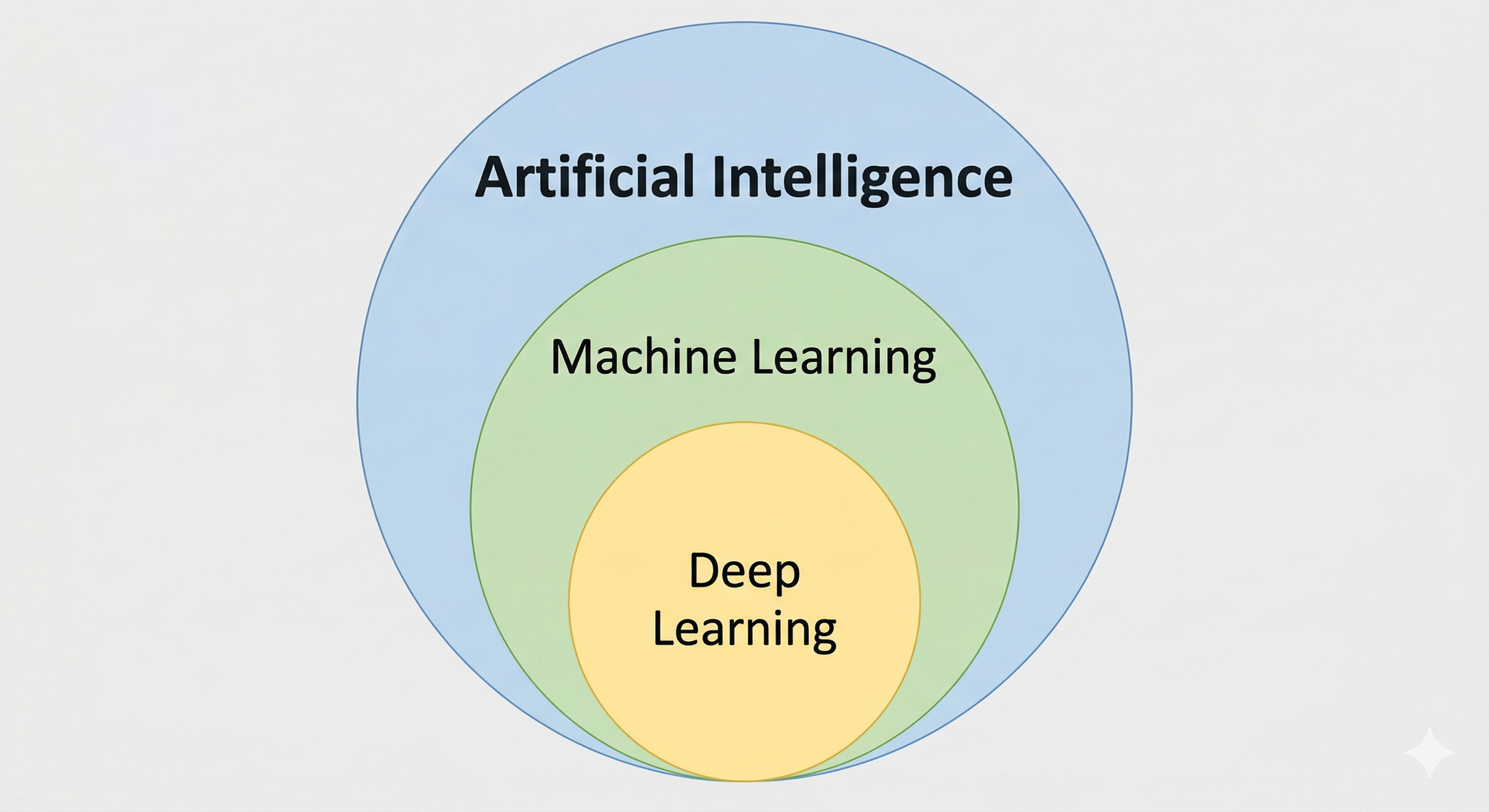
That distinction matters because people often use these terms as if they mean the same thing. They do not. Deep learning is not all of AI, and machine learning is not all of AI either.
The Basic Principles, Without the Jargon
Orsoni’s chapter explains three main ways these systems learn. These are worth understanding because they show up across many psychological applications.
Supervised Learning: Learning From Known Examples
In supervised learning, the system is trained using examples where the answer is already known. It studies the relationship between the input and the correct outcome, then uses that pattern to make predictions about new cases.
In plain language, this is like learning from an answer key.
A psychology example would be feeding in assessment or clinical data from past cases where the diagnosis, outcome, or classification is already established. The system then tries to learn which patterns are associated with which result.
This matters because many professional tasks in psychology involve some kind of prediction or classification. A system may be trained to estimate academic risk, distinguish between clinical groups, or identify cases that may need closer attention.
Unsupervised Learning: Finding Patterns Without an Answer Key
Unsupervised learning starts without a known label or answer. Instead, the goal is to find patterns, group similar cases together, or simplify large amounts of information into something more manageable.
In plain language, this is pattern finding rather than answer matching.
This can be especially useful in psychology because people who share the same label or diagnosis may still look quite different from one another. An unsupervised approach may detect subgroups, profiles, or hidden structure that are easy to miss when using broad categories alone.
That makes this approach relevant when researchers or practitioners want to better understand variation within a population rather than simply sort people into preexisting boxes.
Reinforcement Learning: Trial and Error With Feedback
Reinforcement learning is a trial-and-error approach where an AI agent learns to make optimal decisions by interacting with its environment. Just like operant conditioning, the system receives a reward, which is a numerical form of reinforcement, after an action. This teaches it which behaviors lead to the best long-term outcomes. Over time, it develops a strategy aimed at maximizing this cumulative reinforcement.
For readers in psychology, this is often the most intuitive comparison. The basic logic is familiar: behavior is shaped by consequences.
In practice, this can be useful when a system must decide what to do next in a sequence. In assessment, for example, it may help a computerized test choose the next best item based on earlier responses. In learning contexts, it may help a system adapt to how a student is performing over time.
What Comes Next in Part 2
This first post focused on the foundations: what artificial intelligence, machine learning, and deep learning mean, and the main ways these systems learn.
In Part 2, the focus shifts from concepts to applications. I will look at how these methods may be used in neuropsychology, what they could mean for psychometrics and psychological testing, and how they are beginning to shape educational psychology and clinical psychology.
Understanding the terms is the first step. The next question is the practical one: what do these tools actually look like in use?
What Comes Next in Part 2
This first post focused on the foundations: what artificial intelligence, machine learning, and deep learning mean, and the main ways these systems learn.
In Part 2, the focus shifts from concepts to applications. I will look at how these methods may be used in neuropsychology, what they could mean for psychometrics and psychological testing, and how they are beginning to shape educational psychology and clinical psychology.
Understanding the terms is the first step. The next question is the practical one: what do these tools actually look like in use?
Final Takeaways
Artificial intelligence, machine learning, and deep learning are related, but they are not interchangeable terms.
Supervised learning, unsupervised learning, and reinforcement learning each describe a different way that AI systems learn from data or feedback.
These basic concepts matter because many questions in psychology involve complex patterns rather than simple one-to-one relationships.
Understanding the basic principles makes it easier to evaluate later claims about how AI may be used in assessment, learning, and clinical practice.
AI Use Disclosure - Portions of this post were drafted with the assistance of an AI writing tool and revised by the author for accuracy, clarity, and professional judgment.