Key Takeaways
AI could advance medicine, education, clean energy, and economic productivity, but those capabilities do not guarantee improvements in people’s lives.
Access, ownership, institutional incentives, and public policy will shape who benefits and who bears the costs.
Optimism about AI’s potential and skepticism about its implementation can help us ask better questions.
Communities and professionals have a role in demanding evidence, accountability, and meaningful public benefit.
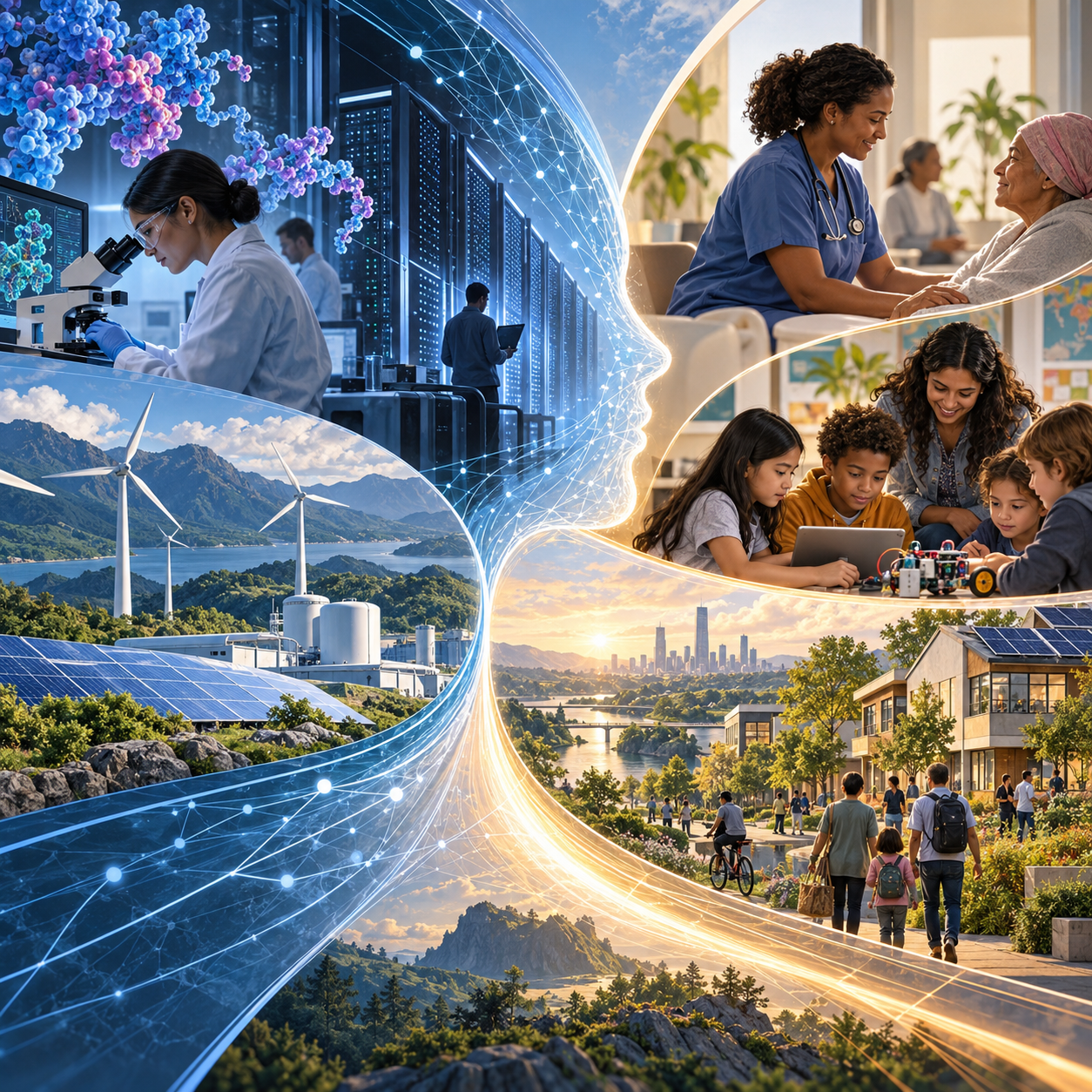
An optimist’s hopes, a skeptic’s doubts, and why the future of artificial intelligence is ultimately up to us.
“Technology is neither good nor bad; nor is it neutral.”
— Melvin Kranzberg, First Law of Technology (1986)
I normally write and speak about artificial intelligence in psychology and education: the implications for professional practice, the opportunities, the risks, and the ethical decisions we face. That work matters to me. But between giving presentations, talking with professionals and researchers, and reading a seemingly endless stream of AI news, I sometimes want to pull back from the questions specific to our fields and consider something bigger.
What will this technology mean for society? Will it reduce suffering and expand opportunity? Or will it reinforce the inequalities and systems that already shape our lives?
Sometimes I’m a Pollyanna about AI. Other times, I’m a cynic. And the more I learn, the more I find myself moving between those two perspectives.
Kranzberg’s First Law of Technology seems like the right starting point. Technology is not inherently good or bad, but it is not neutral. Its consequences emerge through the people, institutions, incentives, and political and economic systems surrounding it. In other words, what AI makes possible is not necessarily what society will choose to do with it.
The Pollyanna: Imagine What AI Could Make Possible
On my optimistic days, I imagine a future in which AI accelerates scientific discovery, helps address climate change, improves education and healthcare, and creates unprecedented economic prosperity. I see possibilities for improving lives that would have seemed unimaginable just a few years ago. Some of those possibilities are genuinely exciting.
Medicine: Scientific discoveries at a different speed
Consider medicine. AI could accelerate drug discovery, improve diagnostic accuracy, identify potential treatments, and help researchers understand diseases that have resisted progress for decades. We are beginning to see concrete examples, even if they remain early-stage.
On September 18, 2026, Reuters reported that Anthropic had established a physical biology laboratory to conduct experiments beyond computer simulations. On October 20, 2026, Anthropic reported that Claude had designed proteins aimed at scorpion neurotoxins; 17 of 211 candidates tested in laboratories met its binding criteria. That is not a working antivenom, and the proteins have not been shown to neutralize venom. But as a glimpse of what faster discovery might look like—particularly for neglected health problems—it is compelling.
The environment: Better technology, smarter systems
Now consider the environment. AI could help researchers develop better batteries and materials, improve renewable energy forecasting, optimize electrical grids, and find ways to reduce energy consumption. Those advances could be important at precisely the moment we need them.
In a September 23, 2026 interview with Ezra Klein, NVIDIA CEO Jensen Huang argued that AI’s growing energy demand could ultimately accelerate investment in cleaner energy, even while acknowledging that additional fossil fuel use is likely in the near term. And on January 30, 2026, SpaceX filed a proposal with the Federal Communications Commission for solar-powered orbital data centers—an ambitious concept intended, in part, to move computing infrastructure off Earth. Such systems would still need electricity and would introduce other environmental and technical challenges, but the scale of the ambition is remarkable.
Economic prosperity: Could the benefits be shared?
AI could increase productivity across industries, enable small organizations to do things once reserved for large institutions, and create new forms of scientific and economic value. Ideally, that prosperity would translate into greater opportunity and a better quality of life for more people.
There are signs that some industry leaders are thinking about how those gains might be shared. On October 18, 2026, Anthropic announced a public benefit fund initially involving 5% of its equity, subject to shareholder approval. Combined with earlier founder and employee commitments, Anthropic said approximately 20% of company shares would be dedicated to public benefit. The following day, Elon Musk pledged to give one of his personal SpaceX shares to every child in America in 2027. The implementation details remain unclear, and pledges are not completed distributions. Nevertheless, these are striking examples of technology leaders publicly acknowledging that the benefits of extraordinary wealth creation should extend beyond themselves.
Psychology and education: More time for people
In education and psychology—fields close to my own work—I see similar potential. AI could reduce administrative burdens, help professionals synthesize research, support individualized instruction, and create more time for the relationships at the center of effective practice. Those would be meaningful improvements.
But I have also written about the Red Queen Effect in an earlier blog post (March 28, 2025) and a follow-up on April 2, 2026: as technology makes us more efficient, expectations can rise just as quickly, leaving us running faster simply to stay in the same place. I’ll return to that concern, because it captures the tension between technological capability and actual human benefit.
The optimist in me looks at these possibilities and wonders whether we are entering an era of progress unlike anything we have experienced before.
The Cynic: What Actually Changes—and for Whom?
Then my cynical side starts asking questions. We already live in a world with extraordinary wealth, yet millions of people struggle to afford housing, healthcare, and other necessities. We already have solar panels, wind turbines, electric vehicles, heat pumps, and increasingly capable energy-storage technologies, but we have struggled to deploy cleaner options at the pace the climate crisis requires. And we already possess lifesaving treatments that are inaccessible to many of the people who need them.
So why should we assume that even more powerful technology will solve problems we have not been willing—or able—to solve with the resources we already possess?
Wealth creation is not wealth distribution
The United States is one of the wealthiest nations in history. My skepticism is not that AI cannot create tremendous additional wealth. It is that creating wealth and distributing wealth are two very different problems. The International Monetary Fund warned in January 2024 that AI could boost productivity while worsening income and wealth inequality, depending on who owns the technology, which workers benefit, and how societies respond to disruption.
I appreciate the significance of Anthropic’s public benefit commitment and Musk’s proposed share distribution. If carried through effectively, they could benefit a great many people. But my cynic asks: Should the distribution of wealth generated by transformative technologies depend primarily on the generosity of the people and companies that control them? Who decides which causes matter, who qualifies, or how much is enough? And does donating a portion of newly created wealth change the structures that concentrate wealth and power in the first place?
Philanthropy can do important good. It is not, by itself, a substitute for fair wages, broad opportunity, access to education, effective social policy, and institutions that give ordinary people a voice in economic decisions.
Environmental costs now, promised benefits later
Climate change raises a parallel problem. Even some of AI’s most enthusiastic advocates acknowledge the near-term environmental burden of building more data centers, manufacturing hardware, and supplying electricity. The optimistic case often asks us to accept those costs today because AI may improve energy systems tomorrow.
The International Energy Agency projected in April 2025 that global data-center electricity demand would more than double by 2030, to about 945 terawatt-hours. That forecast is for data centers overall, not exclusively AI, though AI is a major driver. The IEA also found that AI could help reduce emissions through widespread adoption in industry, transportation, buildings, and energy systems—but warned that those benefits are not guaranteed. Adoption, incentives, infrastructure, regulation, and rebound effects matter.
Space-based computing illustrates the distinction. Moving data centers into orbit might someday offer advantages, but an FCC application is not proof that the concept works at scale—or that its overall environmental footprint would be lower after accounting for manufacturing, launches, orbital operations, and replacement. Computers in space still consume electricity; they would simply obtain it differently.
We know how powerful existing renewable technologies can be. Yet political interests, fossil-fuel dependence, lobbying, financing, and regulatory choices all influence whether they are adopted. If those forces have slowed our response to climate change for decades, why should we assume they will suddenly disappear when AI proposes a solution? The environmental costs are increasingly tangible; many of the promised environmental benefits remain conditional.
A discovery is not the same as an accessible treatment
The same distinction applies to medicine. Imagine that AI helps researchers discover a revolutionary cancer treatment. That would be an extraordinary scientific achievement. But what happens next? Who owns the intellectual property? How much will it cost? Will insurance cover it? Will patients in low-resource settings have access? Will companies prioritize the greatest public-health need or the greatest financial return?
The scorpion-protein experiment brings this dilemma into focus. Designing a molecule that binds to a toxin is an encouraging discovery; showing that it safely neutralizes venom, producing it at scale, and making an affordable antivenom available to affected communities are different—and potentially harder—achievements. None follows automatically from the first.
Discovering a treatment is a scientific achievement. Ensuring that people can access it is a social and political achievement. AI might accelerate the first without guaranteeing the second.
Working faster does not mean living better
In psychology and education, the risk may be less dramatic but immediately familiar. Suppose AI cuts the time required to write an assessment report. Do we get more time for counseling, consultation, prevention, or our own families? Or does the expected turnaround time shrink while caseloads grow? Do teachers gain the freedom to focus on students, or does every efficiency become another expectation?
As I argued in my Red Queen Effect posts, the benefits of speed can be absorbed by institutions almost as quickly as they are produced. Greater capacity can become heavier workloads rather than improved well-being. Without deliberate choices, we may end up working faster without feeling that we have moved forward at all.
Both Perspectives Are Necessary
Perhaps the Pollyanna and the cynic are both right. The optimist sees what technology makes possible. The cynic asks what institutions and incentives will allow to happen. These perspectives are not opposites so much as necessary checks on each other.
Uncritical optimism invites us to assume technological progress will inevitably become social progress. Excessive cynicism creates a different problem: if we assume that powerful interests will inevitably capture the benefits, we may retreat into passivity and surrender whatever influence we do have.
That is why I keep coming back to Kranzberg. AI is not an independent force arriving to decide humanity’s future. It is being built, financed, purchased, regulated, and deployed by people. Its consequences will be shaped by choices—some made in corporate boardrooms, but others made in legislatures, schools, clinics, workplaces, professional associations, and communities.
What Can We Actually Do?
I do not think the answer is to reject AI or to applaud every new capability. It is to become more intentional about the outcomes we demand, and more willing to participate in the decisions that determine them.
Ask who benefits. When a company promises greater productivity, better healthcare, or a cleaner future, ask who receives the gains, who bears the risks, and what evidence shows that the promised benefit has actually occurred.
Demand evidence and accountability. Support independent evaluations, meaningful transparency, privacy protections, and mechanisms to challenge harmful decisions. Announcements, demonstrations, and forecasts are starting points—not proof of public benefit.
Make affected communities part of the process. Students, patients, workers, families, and communities should have a say before consequential AI systems are deployed, especially when those systems could change access to services, workload, or opportunity.
Protect the human benefits of efficiency. At work, decide where time savings will go. Will they support better services, more humane workloads, and stronger relationships—or simply higher output targets? Make that choice explicit.
Advocate beyond your own screen. Participate in professional organizations, public comment processes, local technology decisions, workplace discussions, and policymaking. Decisions about energy, labor, access, and public investment will matter as much as model capabilities.
We will not agree on every policy or every technological risk. But we should be able to agree that the stakes are too high to leave these questions only to the organizations building the technology.
I remain genuinely excited about what AI could make possible. I also remain skeptical that possibility alone will deliver a fairer, healthier, or more sustainable world.
The question is not simply whether AI will change the world. It is who gets to shape that change—and what we are willing to do to ensure it serves everyone, rather than only those who already hold the most wealth and power.
Final Takeaways
Ask what evidence connects an AI capability to a measurable benefit for the people it is intended to serve.
Include affected communities in decisions about access, risks, and implementation.
Make explicit decisions about how time savings will support better services, relationships, and humane workloads.
Participate in professional, workplace, and public decisions that shape how AI’s benefits and costs are shared.
Sources and Further Reading
Kranzberg’s First Law of Technology (1986), Smithsonian archival summary https://www.si.edu/object/archives/sova-nmah-ac-0266
Reuters, Anthropic’s physical biology lab (September 18, 2026) https://www.reuters.com/world/anthropic-quietly-sets-up-biology-lab-it-ramps-ai-drug-program-2026-09-18/
Anthropic, Claude and scorpion neurotoxin binders (October 20, 2026) https://www.anthropic.com/research/claude-scorpion-toxin-binder-design
The Ezra Klein Show, Jensen Huang interview (September 23, 2026) https://www.ezrakleinbooks.com/episode/jensen-huang-vs-the-ai-doomers/
FCC, SpaceX orbital data center application public notice (February 4, 2026) https://docs.fcc.gov/public/attachments/DA-26-113A1.pdf
Anthropic, “Investing in the public benefit” (October 18, 2026) https://www.anthropic.com/news/public-benefit-fund
Axios, Elon Musk’s SpaceX share pledge (October 19, 2026) https://www.axios.com/2026/10/19/elon-musk-spacex-shares-kids
Lockwood, “The Red Queen Effect: Why AI Might Not Save Us Time” (March 28, 2025) https://lockwoodconsulting.net/blog/the-red-queen-effect-why-ai-might-not-save-us-timeyet
Lockwood, “AI and the Red Queen Effect (Part 2): The Queen Comes to Life” (April 2, 2026) https://lockwoodconsulting.net/blog/ai-and-the-red-queen-effect-the-queen-comes-to-life
International Monetary Fund, AI and the global economy (January 14, 2024) https://www.imf.org/en/blogs/articles/2024/01/14/ai-will-transform-the-global-economy-lets-make-sure-it-benefits-humanity
International Energy Agency, Energy and AI: Executive Summary (2025) https://www.iea.org/reports/energy-and-ai/executive-summary
International Energy Agency, AI and Climate Change (2025) https://www.iea.org/reports/energy-and-ai/ai-and-climate-change
AI Disclosure: Generative AI was used to assist with drafting and editing this post and to create the accompanying image. I reviewed and revised the content and take responsibility for its accuracy and final form.